
The flooring is usually the last thing installed and the first thing damaged. Foot traffic, trolleys, dropped tools, and paint or grout spills all leave marks on tiles that were flawless the day they were laid, and replacing damaged marble or granite costs far more than covering it would have.
A construction site floor protector prevents that, and it costs a fraction of what the damage does. In this guide, Iretex Premier covers why floor protection matters, what to look for, and how to use it properly.
Foot traffic, trolleys, dropped tools, and chemical spills cause most flooring damage on a construction site. Once tiles are laid, everything that happens next puts them at risk.
People walking over the floor carry dust and small stones on their shoes, which scratch and dull polished stone. Trolleys, ladders, and heavy equipment leave scratch marks, and their weight can crack tiles. Dropped tools chip edges and corners. Paint, adhesive, grout, and chemical spills stain marble permanently. Water and dust settle into the joints.
None of this is unusual. It is simply what happens on a working site. The only question is whether the floor is covered when it does.
Yes. A roll of tile protection sheet represents a small share of the cost of replacing damaged marble or granite, and replacement is rarely limited to the material itself. It requires matching the original batch, removing the damaged pieces, relaying the area, and delaying handover.
Protection also prevents disputes. When flooring is covered from the day it is laid, responsibility for any damage at handover is not in question. The floor is delivered in the condition it was installed.
For contractors, that reliability carries more weight than the material cost. A project completed without remedial work is a project completed on schedule.
Real protection needs two things: cushioning that absorbs impact, and a surface that keeps water and dust out. Dust sheets, cardboard, and thin plastic offer neither. They tear, disintegrate when wet, or sit flat against the tile with nothing between.
An EPE floor protector does both. The expanded polyethylene layer absorbs shock and impact, so a dropped tool spreads its force rather than chipping the tile beneath. The laminated film surface resists water, dust, and abrasion, so spills stay on top of the sheet instead of reaching the stone.
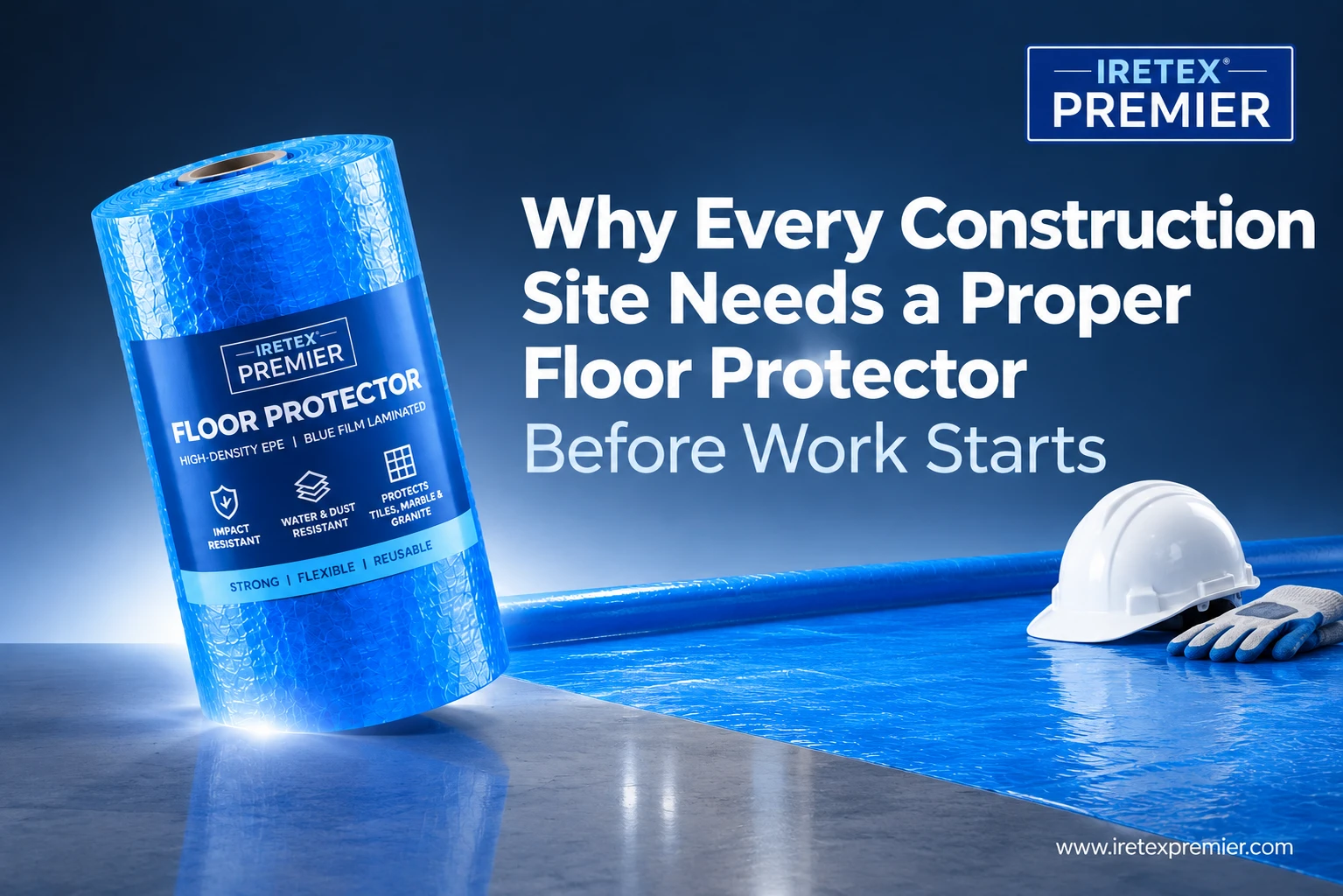
The Premier Floor Protector from Iretex Premier is built on exactly this construction: high-density EPE beneath a blue film laminated surface, protecting against scratches, cracks, and breakage while staying light enough to handle on site.
Thickness should match the traffic the floor will take. Premier Floor Protector comes in three options:
As a rule, the more valuable the flooring and the busier the site, the more cushioning is worth having. Marble and polished granite in a high-traffic commercial project justify 5 mm. A residential floor with limited access can work at 3 mm.
Floor protector for tiles is used during construction, installation, transport, storage, and showroom fit-out, not just on finished floors awaiting handover. It covers laid flooring while other trades work around it, cushions surfaces during installation, prevents tiles chipping against each other in transport, and protects display flooring in showrooms. Granite, stone, and ceramic surfaces all benefit, and the same rolls work across each.
Laying it correctly takes minutes. Clean the surface first, since grit trapped underneath defeats the purpose. Roll the protector out, cut it to size, and secure it with tape where movement is likely. Overlap the edges rather than leaving gaps at the joints, because gaps are where a trolley wheel finds the tile. Remove it once work is complete.
The material is reusable, so sheets lifted carefully from one area can go down in the next. On a phased project, the same Iretex Premier rolls often cover several floors.
Most sites do not skip floor protection. They lay it late, after the first few days of activity have already done the damage. Protection belongs down before the trades arrive, not once someone notices a scratch. A construction site floor protector is one of the cheapest items on a project and one of the few that prevents a cost rather than adding one.
Iretex Premier supplies Premier Floor Protector rolls across India, with 24×7 support and bulk pricing for contractors. Request a bulk quote for the roll sizes and quantities your site needs.
What is a construction site floor protector made of?
Premier Floor Protector uses high-density Expanded Polyethylene, or EPE, with a blue film laminated surface. The EPE absorbs shock and impact while the laminated layer resists water, dust, and abrasion.
What roll sizes are available?
Premier Floor Protector comes in 3 mm rolls of 30 metres and 100 metres, and a 5 mm roll of 70 metres.
Where can floor protection be used?
On tile, marble, and granite flooring during construction, as under-tile cushioning, on renovation sites, during tile transportation and storage, and in showrooms and finished interiors.
Can floor protector rolls be reused?
Yes. Premier Floor Protector is lightweight, flexible, and reusable, so sheets removed carefully from one area can be laid again elsewhere.
Does it protect against water and dust as well as scratches?
Yes. The laminated film surface is water-resistant and dust-proof, so spills and site dust stay on top of the sheet rather than reaching the flooring beneath.
Is it suitable for marble and granite?
Yes. It is designed for tile, marble, granite, stone, and ceramic surfaces, during installation, construction, transportation, and storage.