
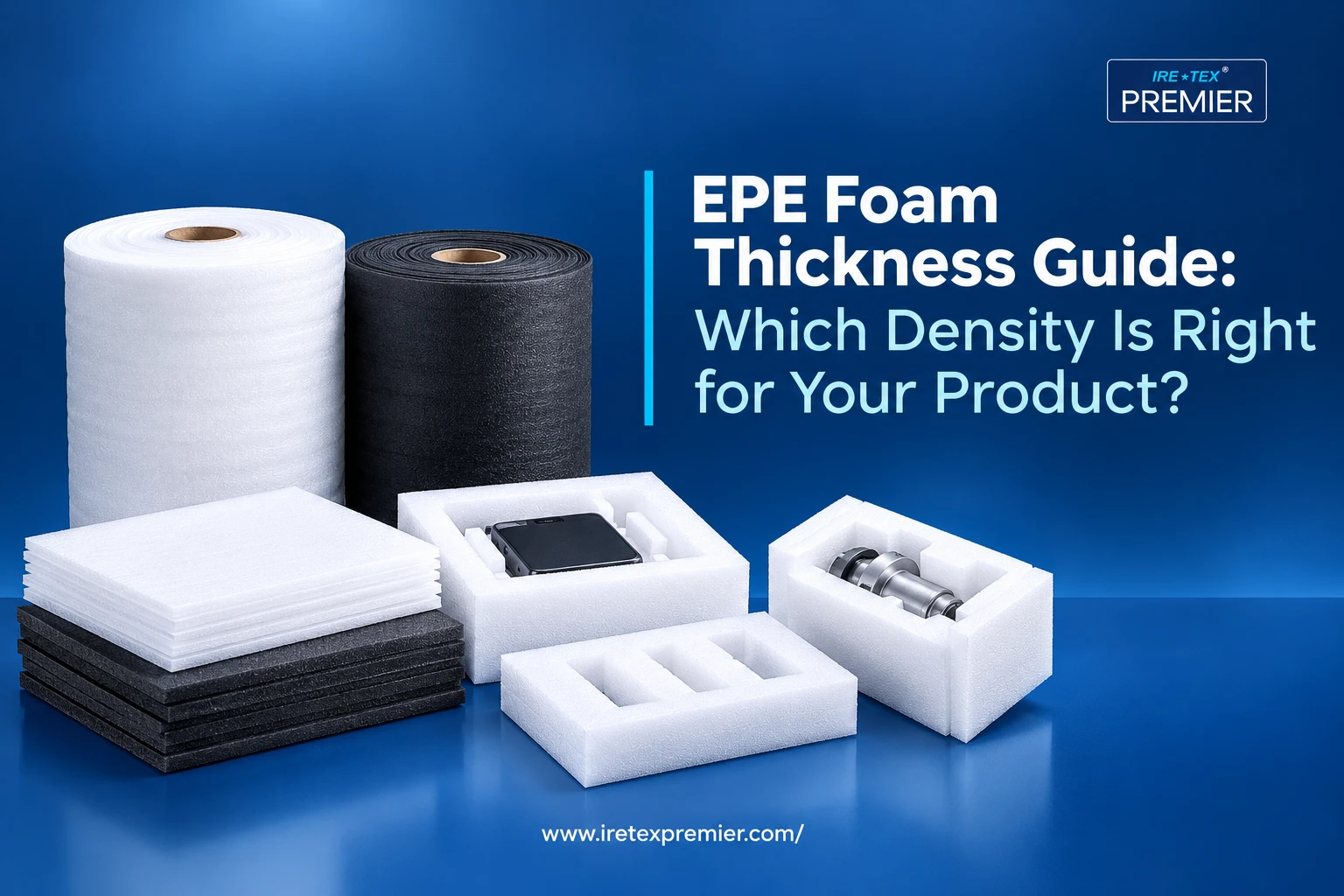
Every year, e-commerce businesses and manufacturers lose money not because their product is poor, but because the packaging around it failed. Using the wrong foam thickness can cause product damage. Ceramic items, electronics, glassware, and automotive components are among the most vulnerable during transit.
Iretex Premier has been manufacturing EPE Foam, one of the most widely used protective packaging materials in India and across the world. It is lightweight and flexible enough to wrap around irregular shapes without tearing.
EPE Foam comes in different thicknesses and densities, and both affect how well it protects your products. Thickness refers to the foam’s physical size, while density determines how much impact it can absorb. The right combination provides the cushioning needed to protect products during shipping.
Most packaging failures are not product failures. They come down to one of four specification errors made before the product ever reached the box.
The table below covers the most common product categories. These are working starting points, not fixed rules. A very fragile item in a lightweight category may need a step up in thickness, and a robust heavy item may need less than the table suggests.
| Product Type | Thickness | Reasoning | IreTex Product |
| Flat documents, printed materials | 2–3mm | Scratch and moisture protection; impact cushioning is not the priority | EPE Foam Sheets |
| Clothing, soft goods, accessories | 3–5mm | Surface protection and volume fill, not structural cushioning | EPE Foam Rolls |
| Books, stationery, small homewares | 5–8mm | Moderate cushioning for items with low fragility | EPE Foam Sheets |
| Small electronics, phones, accessories | 8–10mm | Absorbs drops and side impacts in standard courier transit | EPE Foam Rolls / EPE Buffers |
| Crockery, glassware, ceramics | 10–15mm | Fragile surfaces need more material between them and the box wall | EPE Foam Rolls |
| Power tools, machinery components | 15–20mm | Higher weight combined with moderate fragility | EPE Buffers / Fabrications |
| Medical devices, precision instruments | 20–25mm | High-value, high-fragility: the cost of an error is significant | EPE Buffers / Fabrications |
| Large industrial parts, heavy equipment | 25mm and above | High load weight, potential for point-impact loading | EPE Buffers / Fabrications |
White and black EPE foam from IreTex Premier are the same material, same closed-cell structure, same ISO 9001 manufacturing standards. The only difference is when and where you use them.
White foam is the default for most packaging. If the foam is going inside a shipping box and your customer will never see it, white is the practical choice. The Premier EPE Foam Roll in white covers the majority of standard wrapping and cushioning jobs.
Black foam is for when the packaging is part of what the customer sees. Think premium boxes, display cases, or gift packaging where the foam is visible at unboxing. EPE Foam Sheets in black are the most common format for this.
For buffers and fabrications, colour is not a consideration at all. A custom-cut insert sits inside the box, out of sight. The EPE Buffer specification is about thickness, density, and fit, not appearance.
One thing to be clear on: black EPE foam is not anti-static foam. If you are packing circuit boards or ESD-sensitive components, that is a different product category entirely. Standard EPE foam in any colour is not a substitute for it.
Choosing the right EPE Foam thickness is not complicated once you know what your product actually needs. Match the thickness to the weight, match the density to the fragility, and pick the format that fits your packing operation, whether that is a roll, a sheet, or a custom buffer.
IreTex Premier manufactures every format from its ISO 9001 certified plant near Chennai, with the capacity to handle both retail quantities and large industrial volumes.
Not sure which specification is right for your product? Call or WhatsApp the team, and they will sort it out for you in one conversation.
What is the difference between EPE foam thickness and density?
Thickness is how much foam sits between your product and the box wall. Density is how well it absorbs impact under load.
Which EPE foam thickness is best for shipping glassware or ceramics?
Use 10–15mm. IreTex Premier’s EPE Foam Rolls wrap each piece individually, keeping fragile surfaces from touching in transit.
Should I use foam rolls or foam sheets for e-commerce packaging?
IreTex Premier’s EPE Foam Rolls handle irregular shapes. Their Sheets work for layering between items or lining box bases.
When does it make sense to use EPE buffers instead of wrapping foam?
When you pack the same product daily in volume, a custom buffer is faster, more consistent, and reduces damage claims.
Is EPE foam safe to use for food or pharmaceutical packaging?
EPE foam does not shed particles or absorb moisture, making it suitable for secondary packaging in both categories.